Science Words That Start With I – List of Scientific Terms and Meanings
Words that begin with the letter “I” play a powerful role in shaping our understanding of science and the world around us. From everyday observations to complex scientific principles, “I” words introduce ideas that spark curiosity, deepen comprehension, and inspire discovery. Whether it’s understanding forces like inertia, exploring natural wonders like icebergs, or learning cutting-edge concepts such as immunotherapy and isotopes, these terms open doors to new knowledge across physics, chemistry, biology, earth science, and technology.
Why Do Science Words Starting With I Matters?
Science words that start with “I” matter because they capture many foundational ideas that help explain how the world works. These terms often describe important processes, forces, materials, and technologies. Learning them builds stronger scientific vocabulary, supports clearer understanding in school and real-life situations, and makes complex concepts easier to communicate. By mastering these “I” words, learners gain confidence, improve comprehension, and enhance their ability to think and speak scientifically.
Physics Science Words That Start With I
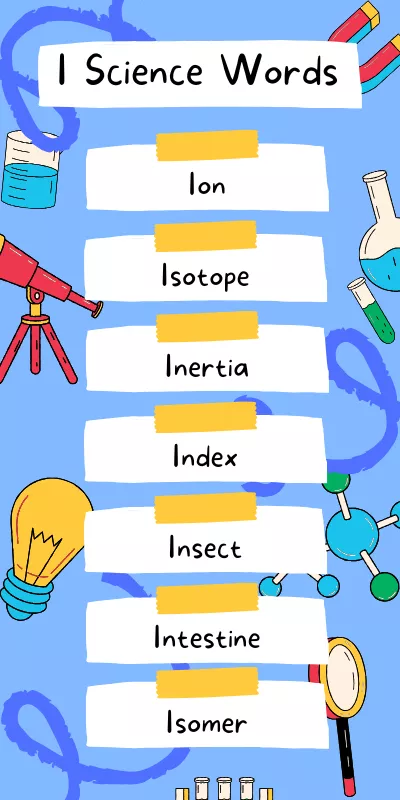
- Inertia – The tendency of an object to resist changes in its motion.
- Impulse – A force applied over time that changes an object’s momentum.
- Intensity – The amount of energy transferred per unit area (often used in waves/light).
- Induction – The process of generating electricity using a changing magnetic field.
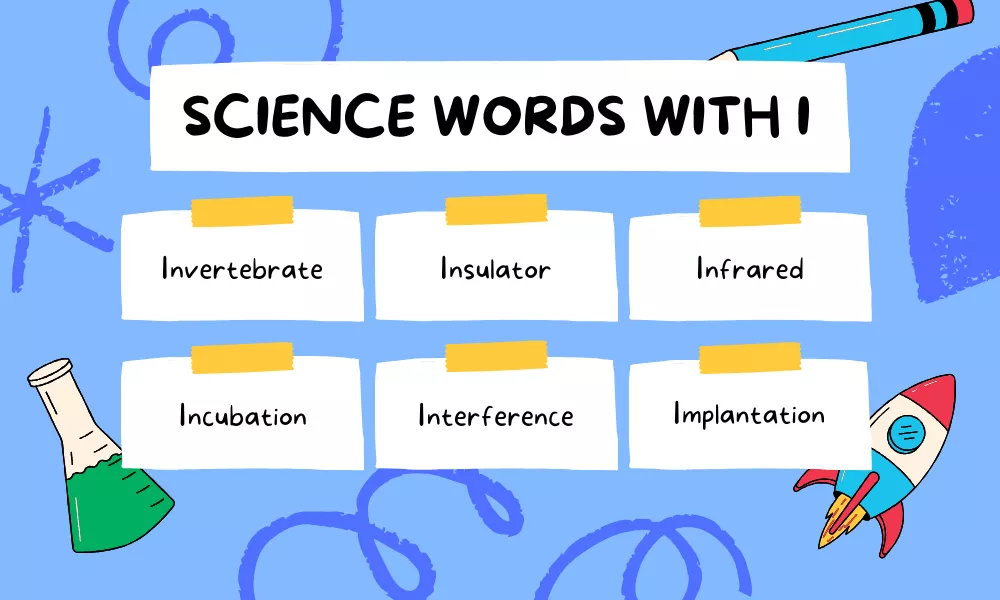
- Insulator – A material that does not allow heat or electricity to pass easily.
- Ionization – The process of adding or removing electrons from atoms or molecules.
- Interference – When two or more waves overlap, creating patterns of reinforcement or cancellation.
- Inelastic Collision – A collision in which objects stick together, losing some kinetic energy.
- Isotope Shift – A small change in atomic spectra caused by different isotopes.
- Inverse Square Law – A law stating that physical quantities like gravity or light weaken with distance squared.
- Inert Gas – A gas that does not easily react and can act as a buffer in physics experiments.
- Isobaric Process – A thermodynamic process that occurs at constant pressure.
- Isochoric Process – A thermodynamic process at constant volume.
- Isothermal Process – A thermodynamic process that occurs at constant temperature.
- Ion Thruster – A propulsion system that uses ionized particles for spacecraft.
- Impedance – Opposition to alternating current in circuits.
- Infrasound – Sound waves with frequencies below human hearing.
- Inversion Layer – A layer in the atmosphere where temperature increases with altitude.
- Irradiance – Power of electromagnetic radiation per unit area.
- Isentropic Process – A thermodynamic process with constant entropy.
Chemistry Science Words That Start With I
- Ion – An atom or molecule with a positive or negative charge.
- Ionic Bond – A chemical bond formed by the attraction between charged ions.
- Isomer – Molecules with the same formula but different structures.
- Isotope – Atoms of the same element with different numbers of neutrons.
- Inhibitor – A substance that slows down or stops a chemical reaction.
- Indicator – A dye that changes color in acids or bases.
- Intermolecular Forces – Attractions between molecules, like hydrogen bonding.
- Ionization Energy – Energy required to remove an electron from an atom.
- Immiscible – Liquids that do not mix (e.g., oil and water).
- Isobar – Molecules or ions with the same mass but different structures.
- Iodine – A halogen element used in disinfection and chemical reactions.
- IUPAC – The organization that sets international chemical naming rules.
- Insoluble – A substance that does not dissolve in a particular solvent.
- Inorganic Compound – A compound not based on carbon–hydrogen bonds.
- Initiator – A chemical that starts or accelerates a reaction, especially in polymerization.
- Ion Exchange – A process where ions are swapped between a solution and a solid.
- Incineration – Chemical decomposition through high-temperature burning.
- Isobaric Reaction – A chemical reaction occurring at constant pressure.
- Interhalogen Compounds – Molecules made of two different halogens (e.g., ICl).
- Inert Atmosphere – A nonreactive gas environment used to prevent unwanted reactions.
Biology Science Words That Start With I
- Immune System – The body’s defense system against infections.
- Immunity – The ability to resist disease through antibodies or immune cells.
- Immunology – The study of the immune system.
- Insulin – A hormone that regulates blood sugar levels.
- Ingestion – Taking food into the body through eating.
- Invertebrate – Animals without a backbone.
- Inherit – To receive genetic traits from parents.
- Infection – Invasion of the body by microorganisms.
- Inflammation – The body’s response to injury or infection.
- Innate Behavior – Behavior that an organism is born with.
- Inhibitor (Biology) – A molecule that slows or stops enzyme activity.
- Interphase – The stage in the cell cycle where the cell grows and replicates DNA.
- Intestine – Digestive organ responsible for absorbing nutrients.
- Isotonic Solution – A solution with the same solute concentration as another solution.
- Insemination – The introduction of sperm to the egg for reproduction.
- Invasive Species – Non-native species that disrupt ecosystems.
- Ion Channel – A protein that allows ions to pass through cell membranes.
- Inhibitory Neuron – A neuron that reduces activity in other neurons.
- Induced Mutation – A mutation caused by radiation or chemicals.
- Imprinting – A form of learning occurring early in life where animals form strong attachments.
Astronomy & Space Science With I
- Interstellar – Referring to the space between stars.
- Ion Tail – The straight, charged particle tail of a comet.
- Impact Crater – A crater formed by a meteorite or asteroid collision.
- Intergalactic – Relating to the space between galaxies.
- Infrared Radiation – Electromagnetic radiation with wavelengths longer than visible light.
- Inclination (Orbit) – The tilt of an orbit relative to a reference plane.
- Ionosphere – A charged region of Earth’s upper atmosphere.
- Ice Giant – A type of planet (like Uranus and Neptune) rich in ices and gases.
- Inner Planets – The rocky planets closer to the Sun (Mercury–Mars).
- Inferior Planet – A planet whose orbit lies inside Earth’s orbit (Mercury or Venus).
- Irregular Galaxy – A galaxy with no clear shape or structure.
- Interplanetary Medium – Gas, dust, and particles that fill our solar system.
- Interstellar Medium – Gas and dust found between stars.
- Interferometry – A technique using combined waves (usually radio waves) to study space.
- Inertia (Orbital) – Tendency of objects in space to remain in motion unless acted on.
- Ion Propulsion – Propulsion using ionized gas for spacecraft.
- Ice Line (Frost Line) – The distance from the Sun where temperatures allow ices to form.
- In Situ Exploration – Studying planetary surfaces directly with probes/rovers.
- Ingress – The beginning of a transit when an object moves onto a celestial disk.
- Interstellar Dust – Tiny particles floating between stars.
Earth & Environmental Science Words Starting With I
- Iceberg – A large piece of freshwater ice floating in the ocean.
- Ice Sheet – A massive layer of glacial ice that covers land.
- Igneous Rock – Rock formed from cooled and solidified magma or lava.
- Infiltration – The process of water soaking into the soil.
- Irrigation – Supplying water to crops using artificial methods.
- Ionosphere – A charged layer of Earth’s atmosphere that affects radio waves.
- Intertidal Zone – The coastal area between high and low tide.
- Inertia (Earth Science) – Resistance of Earth’s moving systems (like wind) to change motion.
- Indicator Species – Species that reveal environmental health by their presence or absence.
- Island Arc – A chain of volcanic islands formed by tectonic activity.
- Isobar – Lines on a weather map showing equal atmospheric pressure.
- Isotherm – Lines on a map that connect places with equal temperatures.
- Ice Core – A cylindrical sample of ice used to study past climates.
- Inversion Layer – A warm layer of air trapped above cooler air, causing smog.
- Impact Event – Collision of Earth with asteroids or meteoroids.
- Interglacial Period – A warmer period between ice ages.
- Impermeable Layer – A rock or soil layer through which water cannot pass.
- Internal Erosion – Movement of soil within a structure due to water flow.
- Industrial Pollution – Contaminants released into the environment from factories.
- Island Biogeography – Study of species distribution on isolated land masses.
Medical & Health Science Words That Start With I
- Immunity – The body’s ability to resist disease.
- Immunization – Giving vaccines to protect against infection.
- Immunotherapy – Using the immune system to fight diseases like cancer.
- Incision – A surgical cut made in the body.
- Inflammation – Swelling and redness caused by infection or injury.
- Infection – Growth of harmful microorganisms in the body.
- Infusion – Slowly delivering medication or fluids into a vein.
- Insulin – A hormone that controls blood sugar levels.
- Imaging (Medical) – Techniques like X-rays and MRI scans to view inside the body.
- Intubation – Placing a tube into the airway to help a patient breathe.
- Intravenous (IV) – Injected or delivered directly into a vein.
- Ischemia – Reduced blood supply to tissues.
- Implant – A medical device placed inside the body.
- Incubation Period – Time between exposure to a pathogen and symptom onset.
- Incontinence – Inability to control urine or bowel movements.
- Inhibitor (Medical) – A drug that blocks certain biochemical processes.
- Inoculation – Introducing a vaccine or weakened pathogen into the body.
- Idiopathic – Describes a disease with no known cause.
- Isotonic Fluids – Medical fluids with equal concentration to body cells.
- Irritant – A substance that causes discomfort or inflammation in tissues.
Technology & Applied Science Words With I
- Innovation – Creating new ideas, products, or technologies.
- Interface – The point where users interact with a computer or machine.
- Information Technology (IT) – Use of computers and networks to store and manage data.
- Input Device – A tool like a keyboard or mouse used to send data to a computer.
- Integrated Circuit (IC) – A tiny electronic chip containing many components.
- Internet – A global network that connects millions of computers.
- Implementation – Putting a plan or system into use.
- Iteration – Repeating a process to improve a design or program.
- Imaging Sensor – A device that captures digital photos or video.
- IoT (Internet of Things) – Everyday devices connected to the internet.
- Indicator Light – A small light showing device status.
- Inverse Kinematics – Robotics method for calculating joint movement.
- Intrusion Detection – Identifying unauthorized access to a network.
- Infrastructure – Basic systems supporting technology (servers, cables).
- Injection Molding – Manufacturing process for shaping plastic.
- Industrial Automation – Using machines and robots to run factories.
- Image Processing – Manipulating digital images using software.
- Interpreter (Programming) – A program that executes code line by line.
- Increment – Small increase used in programming and data science.
- Intelligent System – A system that can learn or make decisions (AI).
You May Also Like: Science Words Start With F
Easy Science Words That Start With I
| Word | Description |
|---|---|
| Ice | Frozen water. |
| Island | A piece of land surrounded by water. |
| Iron | A strong metal used in many tools. |
| Insect | A small animal with six legs. |
| Ivory | Hard white material from animal tusks. |
| Ink | Colored liquid used for writing. |
| Inside | The inner part of something. |
| Idea | A thought or plan. |
| Image | A picture or visual representation. |
| Impact | When one object hits another. |
| Illness | When the body is not healthy. |
| Ingredient | A part used to make something. |
| Increase | To become bigger or grow. |
| Identify | To recognize or name something. |
| Inhale | To breathe in air. |
| Inkling | A small hint or clue. |
| Irons | Heat tools used to straighten or press things. |
| Infant | A very young baby. |
| Invite | To ask someone to join an activity. |
| Interval | A small period of time between events. |
Advanced & Technical Science Words With I
- Isentropic Flow – Fluid flow with constant entropy.
- Isoelectric Point – The pH where a molecule carries no net charge.
- Isothermal Expansion – Expansion at constant temperature.
- Ionization Potential – Energy needed to remove an electron.
- Isomorphic Structures – Crystals that share the same form.
- Immunofluorescence – Technique using fluorescent dyes to detect proteins.
- In-silico Modeling – Computer-simulated biological or chemical experiments.
- Isotachophoresis – A method for separating substances using electrophoresis.
- Interferometry – Technique measuring wave interference for precise data.
- Isobaric Partitioning – A thermodynamic process with constant pressure.
- Inductive Reactance – Opposition caused by inductors to AC current.
- Intravascular Ultrasound – Imaging technique inside blood vessels.
- Isotropic Material – A material with properties the same in all directions.
- Isocline – A curve showing equal slopes in differential equations.
- Ion-exchange Chromatography – Separation of molecules based on charge.
- Immunocytochemistry – Technique to visualize cellular structures using antibodies.
- Isoenzyme – Enzymes that perform the same function but differ in structure.
- Ionospheric Absorption – Loss of radio signals caused by charged particles in the ionosphere.
- Inelastic Scattering – Collision where kinetic energy is not conserved.
- Infrared Spectroscopy – Analytical method to identify compounds using infrared light.
Fun Facts About Science Words That Starting I
- “Inertia” helped shape space exploration
Without inertia, spacecraft wouldn’t glide smoothly through space. Once pushed, they keep moving indefinitely because there’s virtually no friction in space to stop them. - “Isotopes” can tell stories millions of years old
Scientists use isotope ratios in rocks, fossils, and even ice cores to uncover ancient climates, volcanic eruptions, and mass extinction events. - The word “Immunology” grows every year as our immune system learns
The immune system can “remember” pathogens, meaning immunology as a discipline expands continuously as new viruses and treatments emerge. - “Infrared” lets us see heat that our eyes can’t detect
Infrared technology reveals everything from heat leaks in houses to hidden stars in space. - “Interstellar” travel isn’t just sci-fi
Tiny dust particles, meteorites, and even microbes hitch rides between stars, proving that interstellar travel naturally occurs in our universe.
You May Also Like: Science Words Start With G
You May Also Like: Science Words Start With H
FAQs
Conclusion
Science words that start with the letter I open the door to an incredible range of ideas across physics, chemistry, biology, earth science, medicine, and technology. Whether describing powerful forces like inertia, complex processes like ionization, or groundbreaking innovations such as immunotherapy and integrated circuits, these terms help us understand the scientific world with greater clarity and curiosity. Expanding vocabulary with “I” words strengthens scientific literacy, supports academic success, and makes learning more engaging.