Science Words Start With E – Complete List with Meanings
Science is a fascinating field filled with words that help us understand how the world works, and the letter “E” plays an especially important role. From ecosystems that sustain life to electrons that drive chemical reactions, science words starting with E explain essential concepts in biology, chemistry, physics, and environmental science. These terms make complex ideas easier to grasp and help learners describe scientific processes accurately and confidently. This guide explores key science words that begin with E, explained in simple, learner-friendly language, making science more accessible and enjoyable for students of all ages.
Why Do Science Words Starting With E Matters?
Science words that start with E matter because they describe some of the most fundamental processes and elements of the natural world. Terms like energy, evaporation, ecosystem, and evolution help learners understand how living and non-living systems function and interact. These words improve scientific communication, strengthen academic vocabulary, and make it easier to explain experiments, observations, and discoveries clearly. Learning science vocabulary starting with E also builds a strong foundation for advanced studies and encourages curiosity, critical thinking, and a deeper appreciation of science in everyday life.
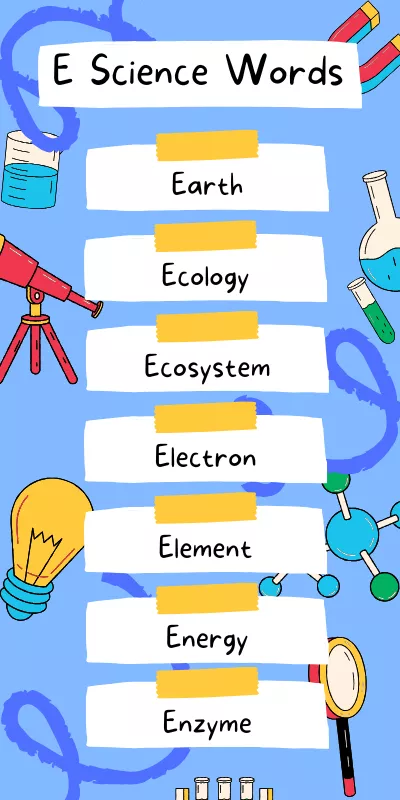
Physics Science Words That Start With E
- Energy – The ability to do work or cause change.
- Electron – A negatively charged subatomic particle.
- Electricity – Flow of electric charge.
- Electric Field – Area around a charge where force is felt.
- Electromagnetism – Interaction between electricity and magnetism.
- Elasticity – Ability of a material to return to its shape.
- Equilibrium – State of balance of forces.
- Entropy – Measure of disorder in a system.
- Emission – Release of energy as light or particles.
- Efficiency – Ratio of useful output to total input.
- Electrostatics – Study of stationary electric charges.
- Eddy Current – Circular electric current in conductors.
- Elastic Collision – Collision conserving energy and momentum.
- Electron Cloud – Region where electrons are likely found.
- Escape Velocity – Speed needed to break free from gravity.
- Electric Potential – Energy per unit charge.
- Energy Transfer – Movement of energy between systems.
- Expansion – Increase in size due to heat.
- Electromotive Force (EMF) – Energy supplied by a power source.
- Excitation – Increase in energy level of a particle.
Chemistry Science Words That Start With E
- Element – Pure substance with one type of atom.
- Electron – Negatively charged particle in atoms.
- Evaporation – Liquid changing into gas.
- Exothermic – Reaction that releases heat.
- Endothermic – Reaction that absorbs heat.
- Equilibrium – Balance between forward and reverse reactions.
- Electronegativity – Ability to attract electrons.
- Electrolysis – Chemical breakdown using electricity.
- Enzyme – Biological catalyst.
- Ester – Organic compound formed from acids and alcohols.
- Emission Spectrum – Light emitted by excited atoms.
- Electron Shell – Energy level around an atom.
- Empirical Formula – Simplest whole-number ratio of atoms.
- Electrochemical Cell – Device converting chemical energy to electricity.
- Energy Level – Fixed energy state of electrons.
- Electrolyte – Substance that conducts electricity in solution.
- Enthalpy – Heat content of a system.
- Evaporation Rate – Speed of liquid turning into gas.
- Extraction – Removing a substance from a mixture.
- Electron Pair – Two electrons in a chemical bond.
Biology Science Words That Start With E
- Ecosystem – Community of organisms and environment.
- Evolution – Change in species over time.
- Enzyme – Protein that speeds up reactions.
- Eukaryote – Cell with a nucleus.
- Endoplasmic Reticulum – Organelle for protein and lipid synthesis.
- Ecology – Study of organisms and their environment.
- Embryo – Early stage of development.
- Excretion – Removal of waste from the body.
- Energy Flow – Transfer of energy in food chains.
- Endocytosis – Cell taking material inside.
- Epidermis – Outer layer of skin.
- Ethology – Study of animal behavior.
- Extinction – Complete disappearance of a species.
- Enzyme-Substrate Complex – Temporary enzyme binding.
- Erythrocyte – Red blood cell.
- Estivation – Dormancy during hot conditions.
- Egg Cell (Ovum) – Female reproductive cell.
- Endoskeleton – Internal skeleton.
- Ecosystem Balance – Stable interaction of organisms.
- Exoskeleton – External body covering.
Astronomy & Space Science With E
- Earth – Third planet from the Sun.
- Eclipse – Blocking of one celestial body by another.
- Elliptical Orbit – Oval-shaped path of planets.
- Equinox – Time when day and night are equal.
- Exoplanet – Planet outside our solar system.
- Escape Velocity – Speed needed to leave a planet’s gravity.
- Ecliptic – Sun’s apparent path in the sky.
- Expansion of Universe – Galaxies moving apart.
- Emission Nebula – Cloud of glowing gas.
- Extraterrestrial – Originating outside
- Earth. Erosion (Space) – Wearing away by cosmic forces.
- Event Horizon – Boundary around a black hole.
- Elliptical Galaxy – Rounded galaxy shape.
- Energy Radiation – Emission of energy as waves.
- Ejecta – Material thrown into space.
- Escape Orbit – Path allowing exit from gravity.
- Exosphere – Outer layer of Earth’s atmosphere.
- Eclipse Path – Track of shadow during eclipse.
- Einstein Ring – Light bending due to gravity.
- Epoch – Specific time period in space history.
Earth & Environmental Science Words Starting With E
- Earthquake – Sudden shaking of Earth’s surface.
- Erosion – Wearing away of soil and rock.
- Ecosystem – Living and non-living things interacting.
- Environment – Natural surroundings of organisms.
- Estuary – Place where river meets the sea.
- Evaporation – Liquid turning into vapor.
- Energy Resource – Natural source of usable energy.
- Emission – Release of gases or particles.
- Ecology – Study of organisms and surroundings.
- Eutrophication – Excess nutrients in water bodies.
- Earth’s Crust – Outermost layer of Earth.
- El Niño – Climate pattern affecting weather.
- Ecosphere – Global ecological system.
- Endangered Species – Species at risk of extinction.
- Environmental Impact – Effect of human activity on nature.
- Earth System – Interacting Earth processes.
- Energy Flow – Movement of energy through ecosystems.
- Evapotranspiration – Water loss from soil and plants.
- Ecoregion – Area with similar environment.
- Earth’s Atmosphere – Gaseous layer around Earth.
Medical & Health Science Words That Start With E
- Enzyme – Protein that speeds chemical reactions.
- Epidemic – Rapid spread of disease.
- Epithelium – Tissue covering organs and skin.
- Endocrine System – Hormone-producing glands.
- Erythrocyte – Red blood cell.
- Electrocardiogram (ECG) – Heart activity recording.
- Edema – Swelling due to fluid buildup.
- Embryology – Study of early development.
- Encephalitis – Brain inflammation.
- Electrolyte – Mineral controlling body functions.
- Excretion – Removal of waste from body.
- Epidermis – Outer skin layer.
- Endoscopy – Internal examination using a scope.
- Enzyme Deficiency – Lack of necessary enzymes.
- Estrogen – Female reproductive hormone.
- Etiology – Cause of a disease.
- Echocardiogram – Ultrasound of the heart.
- Electrotherapy – Use of electricity for treatment.
- Eosinophil – Type of white blood cell.
- Epigenetics – Changes in gene activity.
Technology & Applied Science Words With E
- Engineering – Application of science to design.
- Electric Circuit – Path for electric current.
- Electronics – Study of electronic systems.
- Encryption – Securing digital information.
- Embedded System – Computer within a device.
- Electric Vehicle (EV) – Car powered by electricity.
- Energy Storage – Saving energy for later use.
- Efficiency – Minimum waste of resources.
- Ergonomics – Design for human comfort.
- Electric Motor – Converts electricity into motion.
- Electromechanics – Electrical and mechanical systems.
- E-Waste – Discarded electronic devices.
- Engineering Design – Process of creating solutions.
- Edge Computing – Data processing near source.
- Electromagnetic Sensor – Detects EM signals.
- Energy Conversion – Changing energy form.
- Electric Grid – Network delivering electricity.
- Electroplating – Coating using electricity.
- Electric Power – Rate of energy use.
- Energy Efficiency – Using less energy for same output.
You May Also Like: Science Words Start With B
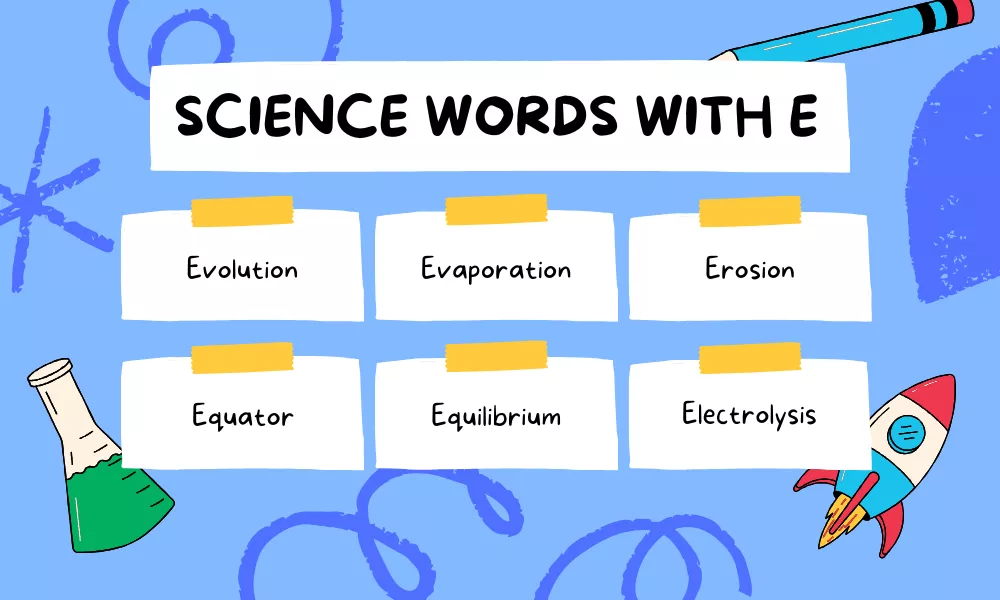
Easy Science Words That Start With E
| Word | Description |
|---|---|
| Earth | Planet we live on. |
| Energy | Power to do work. |
| Environment | Natural surroundings. |
| Evaporation | Water changing into gas. |
| Ecosystem | Living things and surroundings. |
| Electricity | Flow of electric charge. |
| Electron | Tiny charged particle. |
| Experiment | Test to learn something. |
| Element | Basic substance. |
| Energy Source | Where energy comes from. |
| Eclipse | Moon or Sun blocking light. |
| Evaporation Cycle | Water movement process. |
| Elastic | Material that stretches. |
| Egg | Reproductive cell. |
| Earthquake | Shaking of ground. |
| Emission | Giving off energy. |
| Electric Light | Light from electricity. |
| Environment Care | Protecting nature. |
| Erosion | Soil wearing away. |
| Energy Saving | Using less power. |
Advanced & Technical Science Words With E
- Electromagnetism – Interaction of electricity and magnetism.
- Entropy – Measure of disorder.
- Epigenomics – Study of gene regulation.
- Exothermic Reaction – Reaction releasing heat.
- Endothermic Reaction – Reaction absorbing heat.
- Electrophoresis – Separation using electric field.
- Equilibrium Constant – Ratio of reaction products.
- Excitation Energy – Energy raising electron levels.
- Electron Affinity – Attraction for electrons.
- Enthalpy Change – Heat change in reactions.
- Exoplanetary Science – Study of planets beyond solar system.
- Electrochemistry – Chemistry involving electricity.
- Elastic Modulus – Measure of stiffness.
- Evolutionary Biology – Study of species change.
- Ecosystem Dynamics – Changes in ecosystems.
- Electrodynamics – Motion of electric charges.
- Environmental Toxicology – Effects of pollutants.
- Energy Density – Energy per unit volume.
- Eukaryogenesis – Origin of complex cells.
- Exobiology – Study of life beyond Earth.
Fun Facts About Science Words That Starting E
- “Electron” was named before it was seen
Scientists coined the word electron from the Greek word ēlektron (amber) long before they could actually observe electrons. - “Ecosystem” is a surprisingly modern term
The word ecosystem was first used in 1935, making it much newer than many people think for such a fundamental biology concept. - “Energy” is used in almost every science branch
Few science words are as universal as energy, it appears in physics, chemistry, biology, environmental science, and even medical science. - “Evolution” doesn’t always mean slow change
In science, evolution can happen rapidly through sudden genetic shifts, especially in microorganisms. - “Entropy” is often misunderstood
While commonly described as “disorder,” entropy more accurately measures how energy spreads out in a system.
You May Also Like: Science Words Start With C
You May Also Like: Science Words Start With D
FAQs
Conclusion
Science words that start with E play a powerful role in helping us understand the natural world, from tiny electrons inside atoms to vast ecosystems that support life on Earth. These terms appear across all scientific fields, including physics, chemistry, biology, medicine, environmental science, and technology. Learning and using science vocabulary starting with E strengthens scientific literacy, improves communication, and builds a strong foundation for academic success. Whether you are a student, teacher, or curious learner, mastering these “E” science words makes complex ideas clearer, more engaging, and easier to explore.