Science Words That Start With S – Definitions, Examples, and Scientific Terms
The letter “S” stands as one of the most significant and versatile letters in the language of science. From the microscopic world of cells and species to the cosmic scale of stars, “S” introduces a spectrum of terms that shape our understanding. Whether it’s the structure of substances in chemistry, the study of systems in biology, or the search for new solutions in technology, science words beginning with “S” represent structure, and significance. By learning and understanding these scientific terms, we strengthen not only our language skills but also our ability to interpret and engage with the world around us.
Why Do Science Words Starting With S Matters?
Science words that begin with “S” matter because they represent some of the core foundations of scientific knowledge. Words like science, system, structure, solution, species, and sustainability are central to how we study and explain natural phenomena. These terms help organize complex ideas into understandable concepts, making communication in classrooms, laboratories, and research fields more precise and effective. Additionally, many essential scientific processes and discoveries are described using “S” words; such as synthesis, simulation, spectrum, and symbiosis.
Physics Science Words That Start With S
- Scalar – A quantity with magnitude only (e.g., speed, mass).
- Spectrum – The range of wavelengths of electromagnetic radiation.
- Superconductivity – Zero electrical resistance at very low temperatures.
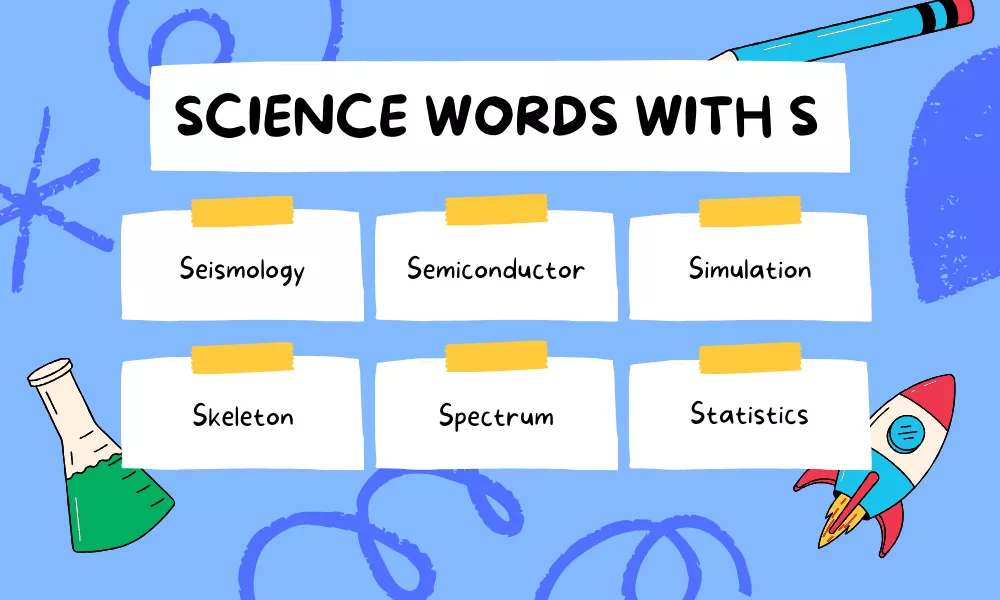
- Semiconductor – A material with conductivity between conductor and insulator.
- Spin – Intrinsic angular momentum of particles.
- Stress – Force applied per unit area.
- Strain – Deformation caused by stress.
- Superposition – Overlapping of waves or quantum states.
- Sound – A mechanical wave traveling through a medium.
- Static Electricity – Electric charges at rest.
- Solenoid – A coil of wire generating a magnetic field.
- Symmetry – Balanced proportions in physical systems.
- Scattering – Deflection of particles or waves.
- Surface Tension – Cohesive force at a liquid’s surface.
- Specific Heat – Heat required to raise temperature of a substance.
- Speed – Distance traveled per unit time.
- Space-Time – The four-dimensional fabric of the universe.
- Spectroscopy – Study of interaction between matter and radiation.
- Supernova – Explosive death of a massive star (studied in astrophysics).
- Singularity – A point of infinite density, such as in black holes.
Chemistry Science Words That Start With S
- Solution – A homogeneous mixture of substances.
- Solute – Substance dissolved in a solvent.
- Solvent – Substance that dissolves the solute.
- Sublimation – Solid changing directly into gas.
- Synthesis – Formation of compounds from simpler substances.
- Salt – Ionic compound formed from acid-base reaction.
- Stoichiometry – Calculation of reactants and products in reactions.
- Solubility – Ability of a substance to dissolve.
- Standardization – Determining exact concentration of a solution.
- Spectrometry – Measurement of chemical species using light.
- Surfactant – Substance reducing surface tension.
- Saturated Solution – Contains maximum dissolved solute.
- Supersaturated – Contains more solute than normally possible.
- Substrate – Substance on which a reaction occurs.
- Strong Acid – Acid that completely ionizes in water.
- Strong Base – Base that fully dissociates in solution.
- Stereochemistry – Study of spatial arrangement of atoms.
- Solvation – Interaction between solvent and solute particles.
- Solidification – Liquid turning into solid.
- Sulfur – A nonmetal chemical element (S).
Biology Science Words That Start With S
- Species – Group of organisms that can reproduce.
- Symbiosis – Close relationship between organisms.
- Stimulus – Environmental change causing response.
- Spore – Reproductive cell in fungi and plants.
- Skeleton – Structural framework of organisms.
- Stomata – Tiny pores on leaves for gas exchange.
- Saprophyte – Organism feeding on dead matter.
- Sexual Reproduction – Reproduction involving two parents.
- Selection (Natural Selection) – Process driving evolution.
- Synapse – Junction between nerve cells.
- Sperm – Male reproductive cell.
- Somatic Cell – Any body cell excluding reproductive cells.
- Secretion – Production and release of substances.
- Spinal Cord – Part of central nervous system.
- Stem Cell – Undifferentiated cell with developmental potential.
- Succession – Gradual ecological change in ecosystems.
- Symmetry – Balanced body structure.
- Sustainable – Capable of maintaining ecological balance.
- Salivary Glands – Produce saliva for digestion.
- Serotonin – Neurotransmitter affecting mood and behavior.
Astronomy & Space Science With S
- Star – Massive luminous ball of plasma.
- Satellite – Object orbiting a planet.
- Solar System – The Sun and objects orbiting it.
- Supernova – Explosive death of a star.
- Singularity – Core of a black hole.
- Spacecraft – Vehicle designed for space travel.
- Spectroscope – Instrument analyzing light spectra.
- Solar Flare – Sudden burst of energy from the Sun.
- Solar Wind – Stream of charged particles from the Sun.
- Spiral Galaxy – Galaxy with spiral arms.
- Sky – Visible expanse above Earth.
- Space Station – Habitable artificial satellite.
- Star Cluster – Group of gravitationally bound stars.
- Substellar Object – Object smaller than a star (e.g., brown dwarf).
- Sunspot – Darker, cooler region on the Sun.
- Shooting Star – Meteor streaking across the sky.
- Spectral Class – Star classification based on temperature.
- Sidereal Time – Time measured relative to distant stars.
- Space-Time – Four-dimensional continuum of the universe.
- Supercluster – Large grouping of galaxies.
Earth & Environmental Science Words Starting With S
- Sediment – Particles of rock and soil carried by water, wind, or ice.
- Sedimentation – Process of settling of particles.
- Seismic – Related to earthquakes.
- Seismology – Study of earthquakes and Earth’s vibrations.
- Soil – Upper layer of Earth where plants grow.
- Strata – Layers of sedimentary rock.
- Stratigraphy – Study of rock layers.
- Sustainability – Responsible use of natural resources.
- Smog – Air pollution mixture of smoke and fog.
- Solar Energy – Energy from the Sun.
- Salinity – Salt concentration in water.
- Sinkhole – Ground depression caused by collapse.
- Streamflow – Movement of water in streams.
- Surface Water – Water on Earth’s surface (rivers, lakes).
- Subduction – One tectonic plate moving beneath another.
- Savanna – Grassland ecosystem with scattered trees.
- Swamp – Wetland dominated by trees.
- Snowpack – Accumulated snow in a region.
- Storm Surge – Rise in sea level during storms.
- Silt – Fine soil particles.
Medical & Health Science Words That Start With S
- Symptom – Sign of a disease.
- Syndrome – Group of related symptoms.
- Surgery – Medical procedure involving operation.
- Sterile – Free from microorganisms.
- Sepsis – Severe body response to infection.
- Screening – Testing for disease detection.
- Serum – Clear liquid part of blood.
- Sedative – Drug that calms or induces sleep.
- Supplement – Product taken to improve nutrition.
- Suture – Stitch used to close wounds.
- Spasm – Sudden muscle contraction.
- Sprain – Ligament injury.
- Strain – Muscle or tendon injury.
- Scoliosis – Abnormal spine curvature.
- Stroke – Interruption of blood supply to the brain.
- Swelling – Enlargement due to fluid buildup.
- Synapse – Junction between nerve cells.
- Secretion – Release of substances by cells.
- Sanitation – Hygiene practices preventing disease.
- Specialist – Doctor trained in a specific field.
Technology & Applied Science Words With S
- Software – Computer programs and systems.
- Sensor – Device detecting changes in environment.
- Satellite – Technology used for communication/navigation.
- Server – Computer providing services to others.
- Signal – Transmitted electrical or digital message.
- Simulation – Digital modeling of real systems.
- Semiconductor – Material used in electronic devices.
- System – Interconnected components working together.
- Security – Protection of digital information.
- Storage – Data saving technology.
- Streaming – Real-time data transmission.
- Synchronization – Coordinating processes in time.
- Smartphone – Advanced mobile device.
- Scanner – Device that digitizes documents or images.
- Satellite Imaging – Capturing Earth images from space.
- Sustainable Technology – Eco-friendly innovation.
- Supercomputer – Extremely powerful computer.
- Switch – Networking device connecting systems.
- Software Engineering – Design and development of programs.
- Systematic – Organized technical approach.
Easy Science Words That Start With S
| Word | Description |
|---|---|
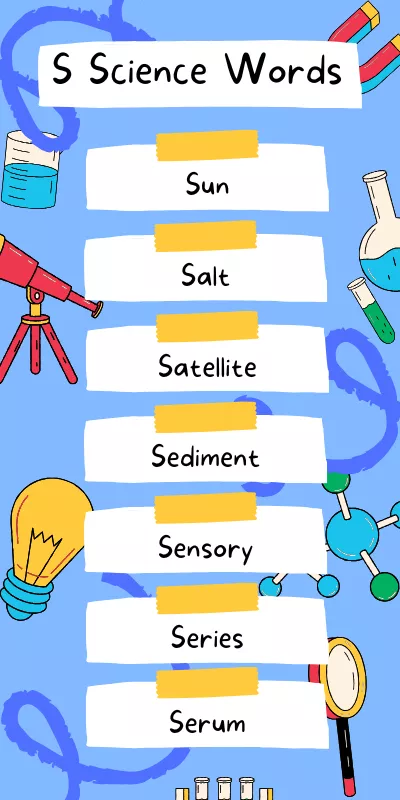
| Sun | The star at the center of our solar system. |
| Star | A glowing ball of gas in space. |
| Seed | Plant embryo. |
| Soil | Earth where plants grow. |
| Sky | Space above Earth. |
| Sound | Noise we hear. |
| Shadow | Dark area blocking light. |
| Steam | Water vapor. |
| Snow | Frozen water crystals. |
| Sand | Tiny rock particles. |
| Shell | Hard outer covering of some animals. |
| Scale | Measuring device. |
| Spine | Backbone. |
| Skin | Outer body covering. |
| Salt | Common mineral substance. |
| Smoke | Gas from burning materials. |
| Stone | Hard solid mineral material. |
| Storm | Severe weather condition. |
| Shore | Land near water. |
| Space | Area beyond Earth. |
You May Also Like: Science Words Start With P
Advanced & Technical Science Words With S
- Spectrophotometry – Measuring light absorption in substances.
- Superposition Principle – Combined effect of overlapping waves.
- Stochastic – Randomly determined process.
- Synchrotron – Particle accelerator.
- Spectroscopy – Study of light-matter interaction.
- Stoichiometric Coefficient – Number in chemical equation.
- Subatomic – Smaller than an atom.
- Spintronics – Technology using electron spin.
- Semipermeable – Allows selective passage of substances.
- Stereoisomerism – Molecules with same formula but different arrangement.
- Sympatric Speciation – Species evolution in same location.
- Subduction Zone – Region where tectonic plates collide.
- Signal Transduction – Cellular response to signals.
- Superfluidity – Frictionless fluid behavior at low temperatures.
- Singularity Theorem – Mathematical concept in relativity.
- Scintillation – Emission of light from radiation interaction.
- Saponification – Soap formation reaction.
- Stratosphere – Atmospheric layer above troposphere.
- Synaptic Plasticity – Ability of synapses to strengthen or weaken.
- Systems Biology – Study of complex biological interactions.
Fun Facts About Science Words That Starting S
- “Science” Itself Starts With S
The word science comes from the Latin scientia, meaning “knowledge.” It’s fitting that so many powerful scientific terms begin with the same letter. - “S” Dominates Space Vocabulary
Many major astronomy terms begin with S, including star, satellite, solar system, supernova, and singularity. The letter S is especially common in space science terminology. - Sulfur Is One of the Oldest Known Elements
Sulfur (chemical symbol S) has been known since ancient times and was used in early medicine and alchemy, making it one of the earliest recorded scientific “S” words. - “Spectrum” Connects Multiple Sciences
The word spectrum is used in physics (light spectrum), chemistry (spectroscopy), medicine (autism spectrum), and even environmental science. One S-word, many scientific fields. - “Symbiosis” Perfectly Describes Science Itself
The biological term symbiosis means different organisms living together in close relationship. Interestingly, modern science works the same way, different branches like biology, chemistry, and physics depend on one another.
You May Also Like: Science Words Start With Q
You May Also Like: Science Words Start With R
FAQs
Conclusion
Science words that start with “S” cover a wide range of concepts across physics, chemistry, biology, astronomy, environmental science, medicine, and technology. From simple terms like sun, soil, and seed to advanced concepts such as stoichiometry, superposition, and synaptic plasticity, these words help explain how the natural world works. Understanding these scientific terms not only improves vocabulary but also strengthens comprehension of important scientific ideas.