Science Words Start With P – Meaning, List, and Scientific Terms
The letter “P” plays a powerful role in the language of science, opening the door to a vast range of terms that explain how the natural world works. Words like photosynthesis, proton, plasma, and phylogeny are not just technical labels; they are key concepts that help us understand life, matter, energy, and evolution. Spanning disciplines such as physics, chemistry, biology, and Earth science, science words starting with P provide precision, depth, and clarity to scientific communication. For students, researchers, and English learners alike, exploring these terms strengthens vocabulary and sharpens comprehension.
Why Do Science Words Starting With P Matters?
Science words starting with P matter because they represent some of the most fundamental principles, processes, and particles that define scientific understanding. Many core concepts begin with P and are essential for explaining how systems behave in chemistry, physics, biology, and environmental science. Learning these terms helps improve scientific literacy, enables clearer communication of complex ideas, and supports academic success. For English learners, mastering P-starting science words also bridges the gap between everyday language and technical terminology, making science more accessible and easier to understand.
Physics Science Words That Start With P
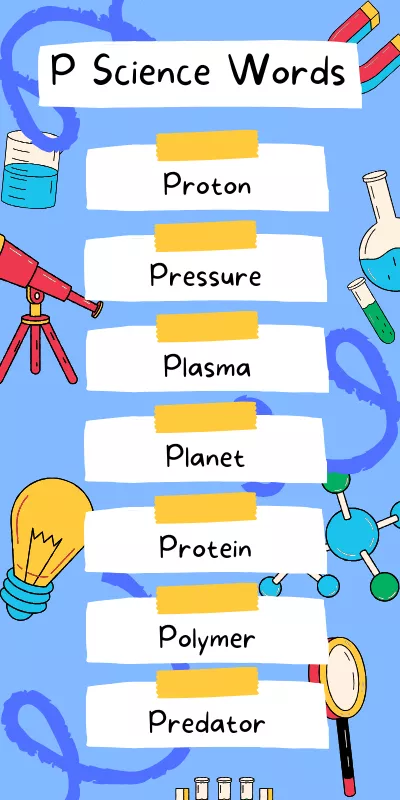
- Photon – A particle of light carrying energy.
- Proton – A positively charged particle in an atom.
- Plasma – A high-energy state of matter.
- Pressure – Force applied per unit area.
- Power – Rate at which work is done.
- Potential Energy – Stored energy due to position.
- Polarization – Orientation of light waves.
- Projectile – An object launched into motion.
- Pendulum – A swinging object under gravity.
- Phase – A distinct state of matter or wave.
- Period – Time for one complete cycle.
- Pascal – SI unit of pressure.
- Parallax – Apparent shift in position due to viewpoint.
- Pulsar – A rotating neutron star emitting radiation.
- Propagation – Movement of waves through space.
- Precession – Change in the orientation of rotation.
- Particle – A small unit of matter or energy.
- Planck’s Constant – Fundamental constant in quantum physics.
- Potential Difference – Voltage between two points.
- Photoelectric Effect – Emission of electrons due to light.
Chemistry Science Words That Start With P
- pH – Measure of acidity or alkalinity.
- Polymer – Large molecule made of repeating units.
- Precipitate – Solid formed in a chemical reaction.
- Proton – Hydrogen ion in chemical reactions.
- Periodic Table – Chart of chemical elements.
- Phase Change – Transition between states of matter.
- Pressure – Force exerted by particles.
- Polar Molecule – Molecule with uneven charge distribution.
- Product – Substance formed from a reaction.
- Particle Theory – Matter made of tiny particles.
- Photochemical Reaction – Reaction driven by light.
- Purification – Process of removing impurities.
- Polymerization – Formation of polymers.
- Partial Pressure – Pressure of a gas in a mixture.
- Protonation – Addition of a proton to a molecule.
- Physical Change – Change without altering composition.
- Phase Diagram – Graph showing states of matter.
- Peroxide – Compound containing oxygen-oxygen bond.
- Precursor – Substance leading to another product.
- Pressure Vessel – Container designed to hold gases.
Biology Science Words That Start With P
- Photosynthesis – Process plants use to make food.
- Protein – Molecule essential for body functions.
- Prokaryote – Cell without a nucleus.
- Pathogen – Disease-causing organism.
- Population – Group of organisms of same species.
- Phenotype – Observable traits of an organism.
- Parasite – Organism living off a host.
- Phylogeny – Evolutionary history of species.
- Pollination – Transfer of pollen in plants.
- Plasma – Liquid component of blood.
- Photosystem – Protein complex in photosynthesis.
- Plasmid – Small DNA molecule in bacteria.
- Primary Consumer – Herbivore in food chain.
- Predator – Organism that hunts others.
- Prey – Organism hunted by predators.
- Permeability – Ability to allow substances through.
- Pheromone – Chemical signal between organisms.
- Parthenogenesis – Asexual reproduction.
- Pulse Rate – Heartbeat frequency.
- Protease – Enzyme that breaks proteins.
Astronomy & Space Science With P
- Planet – Celestial body orbiting a star.
- Pluto – Dwarf planet in the Kuiper Belt.
- Pulsar – Rapidly rotating neutron star.
- Parallax – Method to measure star distances.
- Protostar – Early stage of star formation.
- Photon – Particle of light from stars.
- Planetary Nebula – Glowing shell of gas from dying star.
- Perihelion – Closest point to the Sun.
- Probe – Unmanned space exploration device.
- Plasma – Ionized gas found in stars.
- Precession – Slow change in Earth’s axis.
- Polar Orbit – Orbit passing over poles.
- Planetesimal – Small body forming planets.
- Pioneer – Early space exploration missions.
- Panspermia – Theory of life spreading through space.
- Photometry – Measurement of light intensity.
- Proper Motion – Star’s movement across the sky.
- Prograde Orbit – Orbit in direction of rotation.
- Penumbra – Partial shadow during eclipse.
- Payload – Equipment carried by spacecraft.
Earth & Environmental Science Words Starting With P
- Plate Tectonics – Movement of Earth’s lithospheric plates.
- Pollution – Contamination of air, water, or soil.
- Precipitation – Rain, snow, sleet, or hail.
- Permafrost – Permanently frozen ground.
- Photosphere – Visible surface of the Sun.
- Pedosphere – Earth’s soil layer.
- Paleoclimate – Study of ancient climates.
- Plume – Rising column of magma or smoke.
- Porosity – Ability of soil or rock to hold water.
- Pressure System – Area of high or low atmospheric pressure.
- Phytoplankton – Microscopic ocean plants.
- Protected Area – Land reserved for conservation.
- Peak Flow – Maximum rate of river discharge.
- Particulate Matter – Tiny particles in the air.
- Primary Succession – Ecosystem development on bare land.
- Pesticide – Chemical used to control pests.
- Phosphorus Cycle – Movement of phosphorus through ecosystems.
- Polar Ice Cap – Ice-covered regions near poles.
- Photochemical Smog – Pollution caused by sunlight reactions.
- Plastic Pollution – Environmental harm from plastic waste.
Medical & Health Science Words That Start With P
- Pathology – Study of disease.
- Physiology – Study of body functions.
- Pharmacology – Study of drugs and medicines.
- Prognosis – Predicted outcome of a disease.
- Pandemic – Global disease outbreak.
- Platelets – Blood cells involved in clotting.
- Pulse – Heartbeat felt through arteries.
- Pediatrics – Medical care of children.
- Psychiatry – Study and treatment of mental disorders.
- Prescription – Doctor-authorized medication order.
- Prosthesis – Artificial body part.
- Pathogen – Disease-causing organism.
- Plasma – Liquid component of blood.
- Postoperative – After surgery.
- Preventive Medicine – Focus on disease prevention.
- Palliative Care – Relief-focused medical care.
- Physical Therapy – Treatment to restore movement.
- Polio – Viral infectious disease.
- Placebo – Inactive treatment in trials.
- Pulmonology – Study of lung diseases.
Technology & Applied Science Words With P
- Programming – Writing computer code.
- Processor – Central unit that executes instructions.
- Prototype – Early model of a product.
- Photonics – Technology of light-based systems.
- Power Supply – Source of electrical energy.
- Printed Circuit Board (PCB) – Electronic component platform.
- Predictive Analytics – Data-based forecasting technique.
- Precision Engineering – High-accuracy manufacturing.
- Packet Switching – Data transmission method.
- Parallel Computing – Simultaneous data processing.
- Prototyping – Building experimental designs.
- Power Grid – Network distributing electricity.
- Process Automation – Technology-controlled operations.
- Product Lifecycle – Stages of product development.
- Programmable Logic Controller (PLC) – Industrial control system.
- Photovoltaics – Solar energy technology.
- Performance Testing – System evaluation method.
- Predictive Maintenance – Failure prevention technology.
- Pattern Recognition – Identifying data patterns.
- Portable Device – Easily movable technology.
You May Also Like: Science Words Start With M
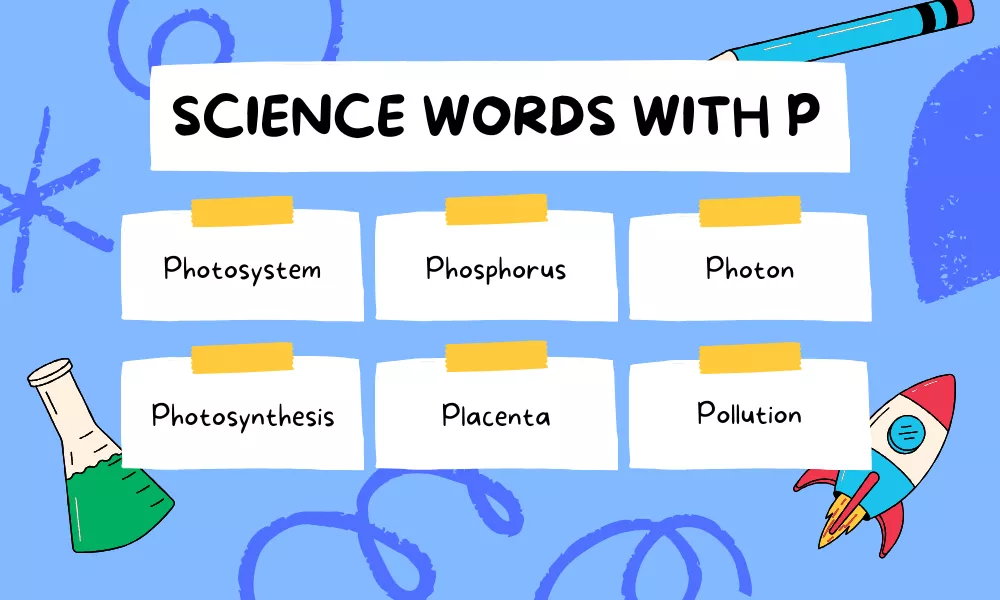
Easy Science Words That Start With P
| Word | Description |
|---|---|
| Plant | Living organism that makes food. |
| Planet | Body that orbits a star. |
| Power | Ability to do work. |
| Push | Force applied to an object. |
| Pull | Force drawing something closer. |
| Photosynthesis | Plants making food using sunlight. |
| Protein | Nutrient for growth. |
| Pollution | Environmental contamination. |
| Pressure | Force over an area. |
| Pulse | Heartbeat. |
| Precipitation | Rain or snow. |
| Pathogen | Germ that causes disease. |
| Plastic | Man-made material. |
| Particle | Very small piece of matter. |
| Plant Cell | Basic unit of plants. |
| Predator | Animal that hunts. |
| Prey | Animal that is hunted. |
| Protect | Keep safe. |
| Poison | Harmful substance. |
| Population | Group of living things. |
Advanced & Technical Science Words With P
- Photolithography – Microchip manufacturing process.
- Paramagnetism – Weak attraction to magnetic fields.
- Polymerase Chain Reaction (PCR) – DNA amplification technique.
- Photoelectric Effect – Light-induced electron emission.
- Proteomics – Large-scale study of proteins.
- Plasmonics – Interaction of light with electrons.
- Paleogenomics – Study of ancient DNA.
- Photocatalysis – Light-accelerated chemical reaction.
- Pharmacokinetics – Drug movement in the body.
- Planetary Accretion – Formation of planets.
- Piezoelectricity – Electricity from pressure.
- Perovskite – Crystal structure used in solar cells.
- Phenomenology – Theoretical framework in physics.
- Proprioception – Sense of body position.
- Phylogenetics – Study of evolutionary relationships.
- Positron Emission Tomography (PET) – Medical imaging technique.
- Photoionization – Ion formation using light.
- Phase Space – System state representation.
- Pseudoscience – Claims lacking scientific basis.
- Polymer Degradation – Breakdown of polymers.
Fun Facts About Science Words That Starting P
- “Photon” has no mass but huge impact
Even though photons are massless, they power everything from sunlight and solar panels to lasers and fiber-optic communication. - “Photosynthesis” literally means “putting together with light”
The word comes from Greek: photo (light) + synthesis (to combine), perfectly describing how plants make food. - “Plasma” is the most common state of matter in the universe
While rare on Earth, plasma makes up stars, lightning, and even the glowing auroras, making it a cosmic superstar word. - Many powerful science prefixes start with P
Prefixes like photo- (light), proto- (first), poly- (many), and para- (beside) help scientists create precise terminology across fields. - “Pandemic” and “planet” share a global idea
Both words come from Greek roots meaning all or entire, showing how science words often reflect scale and scope in their meanings.
You May Also Like: Science Words Start With N
You May Also Like: Science Words Start With O
FAQs
Conclusion
Science words that start with P play a pivotal role in shaping how we understand the natural and technological world. From foundational concepts like protons and photosynthesis to advanced terms such as polymerase chain reaction and photolithography, these words span every major scientific discipline. Learning them enhances scientific literacy, strengthens academic performance, and helps English learners bridge the gap between everyday language and technical communication. Whether you’re a student, educator, researcher, or curious learner, mastering P-starting science words empowers you to explore, explain, and engage with science more confidently and effectively.